


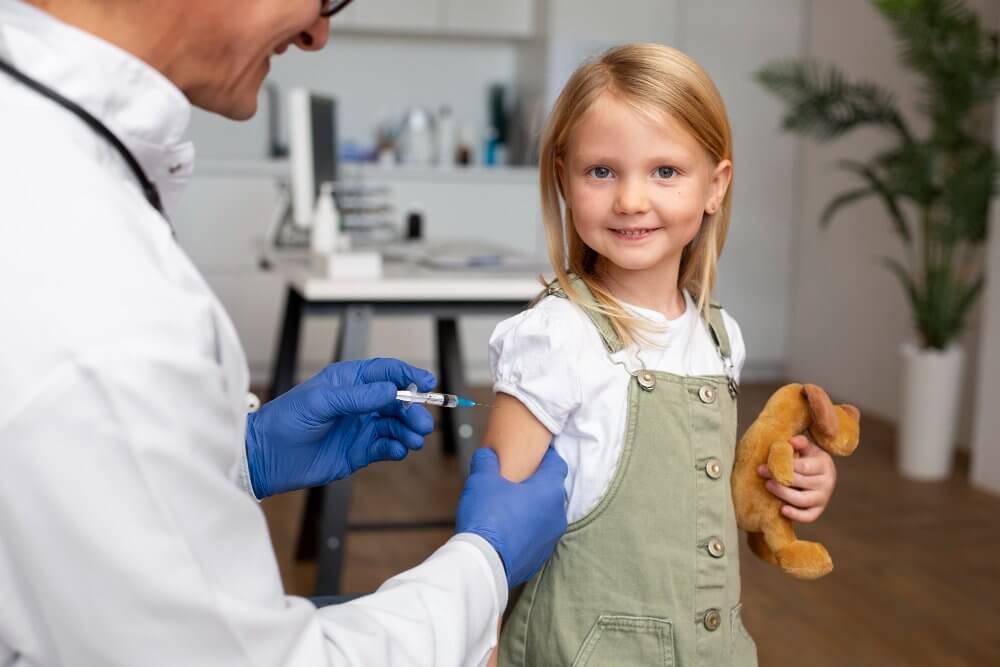
Vaccination in Babies and Children
The vaccination schedule for infants and children is one of the most important health practices for healthy growth and development.
Vaccines protect children from dangerous infectious diseases while also ensuring public health.
As of 2025 , the new childhood vaccination schedule updates, determined by the Turkish Ministry of Health, are in line with international health standards.
Magnet Hospital offers families vaccination schedule counseling, vaccination applications and child health check-up services.
1. What is Vaccine?
Vaccines are liquids prepared in a laboratory environment, consisting of dead or weakened bacteria and viruses, designed to strengthen the body's immune system against disease .
Vaccines are administered to protect the body from disease.
Vaccines can be administered in the arm or leg , depending on preference ; some vaccines need to be administered orally or subcutaneously .
Vaccination is included in the preventive health services that countries offer free of charge to their citizens.
2. What are the types of vaccines?
Vaccines can be classified as live, killed, toxoid, subunit, conjugate, mRNA, vector and protein based.
Vaccination types and descriptions:
a. Live Attenuated Vaccines
A weakened version of disease-causing microorganisms is used.
It can multiply in the body but does not cause disease; it creates a strong immune response.
Examples: Measles-Rubella-Mumps, Chickenpox, Rotavirus, Live Polio (OPV)
b. Inactive (Dead) Vaccines
It is prepared by completely killing microorganisms.
Examples: IPV (Inactivated Polio), Hepatitis A, Influenza vaccine
c. Toxoid (Toxin-Based) Vaccines
Inactivated forms of bacterial toxins are used.
Examples: Tetanus, Diphtheria
d. Subunit Vaccines
Only the immune-producing parts of the microorganism are used instead of the entire microorganism.
Examples: Hepatitis B, HPV, and some meningitis vaccines.
e. Conjugated Vaccines
Weak antigens are combined with other molecules to boost immunity.
Examples: Hib, Meningitis, Pneumonia (Pneumococcal) vaccines
f. mRNA Vaccines
A piece of the virus's genetic information is used to prompt the body to produce protective proteins.
Examples: COVID-19 mRNA (BioNTech, etc.)
g. Vector Vaccines
A harmless virus is used as a carrier.
Examples: COVID-19 (AstraZeneca, Sputnik V)
h. Protein-Based Vaccines
Purified protein fragments produced in a laboratory environment are used.
Examples: Some COVID-19 vaccines, HPV
3. Side Effects and Harms of Vaccines in Babies and Children
Vaccines are the most important preventive health practices developed to protect infants and children from serious and potentially fatal infectious diseases.
As with any medical procedure, vaccines can cause side effects, but most are mild and temporary.
a. Common and Mild Side Effects
Fire
Redness, swelling, or pain in the injection area
Unrest
Fatigue, sleepiness
Anorexia
Insomnia
joint pain
These side effects usually subside within 3–4 days.
Paracetamol can be given if necessary, as recommended by a doctor.
b. Rare Side Effects
Fever over 38.5°C
Hardening and large swelling in the arm/area
Rash or mild allergic reactions
It usually resolves quickly.
c. Rare but Serious Side Effects
Anaphylaxis (severe allergic reaction) — Very rare (1–2 in a million)
Febrile convulsion (seizure due to fever)
Extreme local reaction, bruising, intense swelling
What Families Need to Know
A mild fever after vaccination is normal.
Serious side effects are very rare.
Not vaccinating significantly increases a child's risk of contracting deadly diseases.
If any unusual symptoms (very high fever, difficulty breathing, change in consciousness) are observed, a doctor should be consulted.
4. 2025 Vaccination Schedule Updates
Some changes have been made to the 2025 vaccination schedule for children born after January 1, 2016.
These changes were prepared in line with scientific data and WHO recommendations .
For detailed information, you can visit the Turkish Ministry of Health website.
5. The Importance of Vaccines in Babies and Children
Because babies' immune systems are not fully developed, infectious diseases can be very severe during this period.
Vaccines significantly reduce the risk of death and disability from these diseases.
The Importance of Vaccines:
It provides immunity.
It strengthens community immunity.
It prevents fatal diseases.
It protects future generations.
Magnet Hospital offers regular follow-up and professional counseling to parents.
6. How Do Vaccines Work in Babies and Children?
The immune system recognizes dead or weakened microorganisms administered through vaccines.
These immune cells develop a memory against these microorganisms , and this memory persists for many years.
When the child encounters the same microorganism again, the immune system responds immediately and the disease either does not occur at all or is very mild.
7. What is the Vaccination Schedule?
Countries implement a "vaccine calendar" to ensure herd immunity and prevent diseases in childhood.
In this way:
Infant and child mortality rates decrease.
Epidemics are prevented.
The burden of serious diseases is reduced.
Healthcare expenses are reduced.
8. 2025 Child Vaccination Calendar by Month
a. Vaccinations Given at Birth
Hepatitis B (1st dose)
b. 1st Month Vaccine
Hepatitis B (2nd dose)
c. 2nd Month Vaccine
BCG (Tuberculosis vaccine)
DaBT-IPA-Hib (combined vaccine: diphtheria, pertussis, tetanus, polio, Hib)
KPA (Pneumococcal conjugate vaccine)
Rotavirus (oral, first dose)
d. 4th Month Vaccine
DaBT-IPA-Hib (2nd dose)
KPA (2nd dose)
Rotavirus (2nd dose)
e. 6th Month Vaccine
DaBT-IPA-Hib (3rd dose)
Hepatitis B (3rd dose)
KPA (3rd dose)
f. 12th Month Vaccine
Measles-Mumps-Rubella (KKK)
KPA booster
Varicella
g. 18th Month Vaccine
DaBT-IPA-Hib (booster dose)
h. 4–6 Year Old Vaccinations
DaBT-IPA booster
KKK (2nd dose)
1. Age 9 (Recommended for girls)
HPV vaccine (started to be added to the official calendar as of 2025)
9. Benefits of Following the Vaccination Schedule
Minimizes the risk of disease
Increases school-age health safety
Contributes to the prevention of epidemics
Keeps children's immune system strong
Magnet Hospital provides information to families before and after vaccination.
10. What You Need to Know About Vaccination Practices
Mild fever, rash, and irritability are normal after vaccination.
It is recommended that the child not be sick on the day of the vaccination.
If the vaccine is delayed, it should be made up as soon as possible.
It is very important to store vaccines in cold chain conditions.
11. Things to Consider in Vaccination Applications
a. Timing
It's very important to get your vaccinations on time.
If you miss a dose, you should definitely consult your pediatrician.
b. Cold Chain
The storage conditions, shelf life and cold chain of vaccines must be checked.
c. Side Effects
Families should be informed about possible side effects.
12. Can Different Vaccines Be Administered at the Same Time?
Yes.
Many vaccines can be administered on the same day and are medically safe.
The immune system can respond to more than one antigen simultaneously
Protection is provided faster
It is an application recommended by WHO and the Ministry of Health.
Rarely, pain and mild fever may occur at the injection site.
13. Do Vaccines Cause Autism?
No. There is no scientific evidence
that vaccines cause autism .
The 1998 fraudulent study has been retracted
WHO, American Academy of Pediatrics and scientific organizations: Vaccines do not cause autism
The cause of autism is genetic and environmental factors.
Not getting vaccinated leads to serious health risks.
14. In what cases is vaccination not administered?
| Situation | Explanation | Vaccinations Not Administered/Postponed |
|---|---|---|
| Severe allergic reaction (anaphylaxis) | Severe allergy to the same vaccine | All vaccines containing the relevant allergen |
| Immunodeficiency | Chemotherapy, immunosuppressive therapy | Live vaccines (MMR, Chickenpox, Rotavirus, OPV) |
| Pregnancy | Live virus vaccines are not administered | KKK, Chickenpox, OPV |
| Serious illness with high fever | If the child is seriously ill, the vaccine is postponed. | All vaccines (delayed) |
| Neurological diseases | Epilepsy, encephalopathy | Vaccines containing pertussis |
| Certain age limit | If the appropriate age period for vaccination has passed | Rotavirus etc. |
| Blood/immune globulin therapy | Reduced effectiveness of live vaccines | KKK, Chickenpox |
15. Frequently Asked Questions
a. Why was the 2025 vaccination calendar updated?
In line with new scientific data and international standards.
b. Do vaccines have side effects?
Mild fever and rash may occur; serious side effects are very rare.
c. What if the child gets sick on the day of the vaccination?
A mild cold is not an obstacle; if there is a high fever, it is postponed.
d. Is HPV vaccination mandatory?
It is not mandatory, but recommended for girls over 9 years old.
e. What are live vaccines?
Measles, rubella, mumps, chickenpox, rotavirus, OPV.
f. Application in babies of Hepatitis B carrier mothers?
As soon as the baby is born, Hepatitis B + immune globulin is administered within the first 12 hours.
g. Which vaccine leaves a scar on the arm?
BCG (Tuberculosis vaccine).
h. How are vaccinations tracked?
Vaccination card, through pediatrician and family doctor.
i. Does the government cover the cost of vaccines?
Yes, most vaccines are free.
i. Are vaccines administered in the arm or the leg?
Until the age of 2, from the leg; after the age of 2, from the arm.
j. What are the mandatory baby vaccines?
Hepatitis B, BCG, DaBT-IPA-Hib, KPA, OPV, KKK, Chickenpox, Hepatitis A.
k. Can vaccination be administered while there is an infection?
It is not performed in serious infections; it is not an obstacle to a mild cold.
l. Situations in which live vaccines should not be administered?
Anaphylaxis, immunodeficiency, pregnancy, serious infection, immune globulin therapy.
Vaccination Schedule Table

Safe Vaccine Tracking with Magnet Hospital
Magnet Hospital offers consultancy on the safe administration and monitoring of childhood vaccinations.
magnethastanesi.com.tr
0312 212 8080
