



Color Blindness
Color blindness refers to the partial or complete loss of the ability to perceive or distinguish colors differently than normal. Color blindness is usually an inherited condition and is usually transmitted through the X chromosome. Therefore, men are more likely to experience color blindness than women.
Color blindness results from the failure of the pigments in the cone cells involved in color perception to function normally. The most common type of color blindness is red-green color blindness, which affects the ability to distinguish red, green, or blue. However, in rare cases, blue-yellow color blindness can also occur.
People with color blindness cannot fully distinguish between colors or may confuse some colors. For example, they may confuse red and green or have difficulty distinguishing between different hues. However, people with color blindness often develop various strategies for survival and use other cues to identify colors in their environment.
Color blindness usually requires a medical diagnosis and is evaluated by an ophthalmologist. Color blindness cannot be cured, but many people with color blindness can use aids to better recognize colors in everyday life. For example, some color blindness-correcting glasses can help them see colors more clearly.
What causes color blindness?
Color blindness is usually a hereditary condition, present at birth. It occurs due to pigment abnormalities or deficiencies in the cone cells of the eye. Cone cells are responsible for color perception, which requires the detection of different wavelengths of light.
Color blindness is a trait inherited from the X chromosome. It usually occurs due to an abnormal gene on the X chromosome, inherited from the mother. Therefore, color blindness is more common in males. Because males have both X and Y chromosomes, if the color blindness gene is present on the X chromosome, the Y chromosome cannot be a backup to correct the abnormality. In females, the color blindness gene can be suppressed by both the X chromosome and the normal gene on the other X chromosome, making color blindness less common in females.
Color blindness can occur in varying degrees. Some people are simply unable to distinguish certain colors, while others may have more severe problems with overall color perception.
Color blindness can also occur due to factors such as medical conditions, eye injuries, or medications. Acquired color blindness is different from congenital color blindness and can be treated. However, congenital hereditary color blindness is not treatable.
What are the symptoms of color blindness?
Symptoms of color blindness often include perceiving colors differently or incorrectly. However, symptoms can vary from person to person and depend on the type of color blindness. Common symptoms in color blind people include:
- Red-green color blindness : Red-green color blindness is the most common type. In this condition, red and green hues become difficult to distinguish from each other and, in some cases, are completely mixed.
- Colors appear faded : People with color blindness may describe colors as appearing faded or dull. This difference may be particularly noticeable in shades of red and green.
- Inability to distinguish between different shades: People with color blindness may have difficulty distinguishing certain shades of color from each other. For example, they may have difficulty distinguishing light blue from dark blue, or shades of pink from shades of gray or white.
- Confusing color names : People with color blindness may have difficulty accurately remembering or expressing the names of certain colors. For example, they may call red green.
- Difficulty performing color tasks: Color blindness can cause difficulty in some professions or daily activities (distinguish between traffic lights, use color codes in electrical circuits, etc.).
These symptoms can vary among individuals with color blindness, and some may be milder and others more pronounced. It's important to see an ophthalmologist and have the necessary tests to diagnose color blindness.
How is color blindness detected?
Various tests are used to detect color blindness. These tests, which must be performed by an ophthalmologist or specialist, are used to assess color perception ability. Some of the tests commonly used to detect color blindness include:
- Ishihara test: The Ishihara test is the most commonly used color blindness test. This test requires color blind individuals to distinguish specific shapes or figures among dots of different colors. The figures or figures in the test may be invisible or unnoticeable to color blind individuals.
- Farnsworth-Munsell 100 Hue Test: This test is based on the ordering and arrangement of colors. A person is given a series of colors and is asked to rank or arrange them in a specific order. People with color blindness may have difficulty ordering or arranging colors accurately.
- Color Disc Test: The color disc test is another method used to detect color blindness. In this test, the subject is shown colored discs and asked to identify specific colors or shapes. People with color blindness may have difficulty accurately identifying specific colors or shapes.
These tests are used to determine the type and severity of color blindness. Diagnosis and assessment of color blindness should be performed by an ophthalmologist or specialist. Based on the results of these tests, appropriate strategies or aids can be provided.
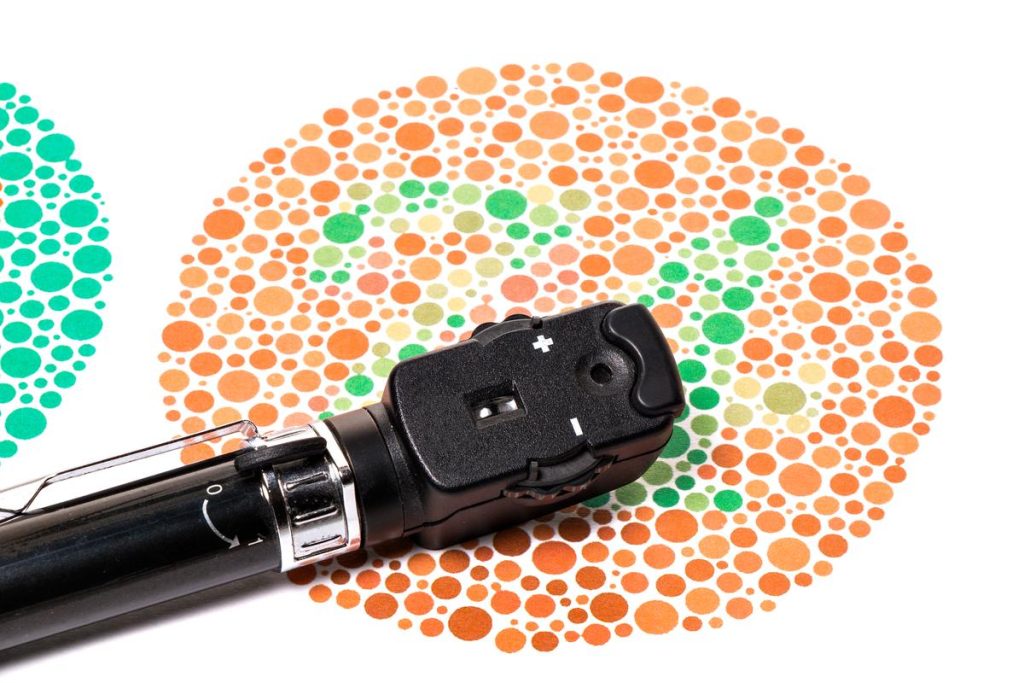
Types and degrees of color blindness
Color blindness can come in different types and degrees. Common types of color blindness include:
- Red-Green Color Blindness : This is the most common type of color blindness. It affects the ability to distinguish red and green. This type of color blindness can be further classified as protan color blindness (red perception problem) or detan color blindness (green perception problem).
- Blue-Yellow Color Blindness: This type of color blindness can affect the ability to distinguish between blue and yellow. This type of color blindness is less common.
The degree of color blindness refers to how accurately a person can distinguish or perceive colors. The degree of color blindness indicates a person's ability to perceive the difference between colors based on their color blindness. Degrees are generally classified as mild, moderate, or severe.
People with mild color blindness can distinguish colors to a large extent and may have little difficulty perceiving different shades.
People with moderate color blindness have more difficulty distinguishing colors and perceive the difference between hues less clearly.
People with severe color blindness have great difficulty distinguishing colors and can sometimes confuse colors completely.
The type and degree of color blindness can vary from person to person, and genetics, gender, and other factors may contribute. An ophthalmologist or specialist can perform appropriate tests to detect and determine the degree of color blindness.
Is there a treatment for color blindness?
Color blindness is usually a hereditary condition and is present at birth. Therefore, it is not possible to completely correct or improve the color perception of people with color blindness.
However, some methods can help you cope with color blindness or better understand colors. These may include:
- Color recognition training: People with color blindness can be trained to learn the specific characteristics, shades, and contrasts of different colors. This way, they can learn to better understand and distinguish colors.
- Color adjustments: People with color blindness can use color combinations or contrasts to make color adjustments easier. For example, they can use color coding or labeling to help identify colored objects or distinguish between different areas.
- Technological aids: Some technological devices or apps are available for people with color blindness. For example, glasses with special filters or color recognition apps can be used to improve color perception.
Although color blindness cannot be cured, such strategies and aids can be used to improve a person's quality of life and make daily activities easier.
