


What is Hyperopia? Symptoms, Causes, and Treatment Options
In healthy eyes, incoming light rays focus evenly on the retina, creating a clear image. However, in cases of hyperopia, these rays focus behind the retina instead of on it. This focusing occurs for various reasons, such as an abnormally small eyeball or insufficient refractive power of the cornea and lens. Hyperopia can be seen in all age groups, from infancy to adulthood, and is treatable.
Hyperopia occurs when refracted light rays in the eye fall behind the retina. This causes the image on the retina to appear blurry. While hyperopia is generally known as an inability to see clearly up close, it can also cause problems with distance vision and is a very common vision disorder. In mild hyperopia, distance vision is generally easier, while up close vision is difficult. However, in severe hyperopia, distance vision can also be affected. As the eye's ability to accommodate decreases with age, blurry vision can occur at both distances and near objects.
Hyperopia is classified according to the degree of refractive error in the eye. A refractive error of less than 2 degrees is considered mild, between 2 and 5 degrees is considered moderate, and 5 degrees or more is considered severe hyperopia.
Hyperopia: Who is it seen in and how?
Hyperopia is a mild condition seen in most babies at birth because their eyes are not fully developed. However, this condition usually resolves spontaneously as babies grow. However, in some babies, hyperopia can persist and, if left untreated, can lead to serious eye health problems such as amblyopia. During childhood and adolescence, distance vision is generally normal, and even near vision may be fine, as the eyes still have the ability to adapt.
However, as we age (over 40), our natural lens begins to lose its flexibility, causing hyperopia (farsightedness) to affect both distance and near vision. This is because, as we age, the lens within the eye loses its flexibility, reducing focusing ability and making it difficult to see clearly near or far.
For the early diagnosis of amblyopia, it's important for all children, especially those between the ages of 6 months and 7, to have regular eye exams. During these exams, eye drops can be used to block the eye's ability to accommodate, if necessary, and to determine true hyperopia. Eye drop exams may be necessary, especially for younger children with strabismus, and even for those with more pronounced hyperopia in one eye.
What are the symptoms of hyperopia?
The most obvious sign of hyperopia is blurring of vision when focusing on a fixed point. This can manifest as an inability to see clearly, especially at close range, but in later stages, distance vision problems can also occur. Hyperopia is often confused with presbyopia. Presbyopia is the inability to see up close due to the loss of flexibility of the lens with age, whereas hyperopia results from the inability of the eye to focus light on the retina due to anatomical shortness or inadequate refractive power of the cornea and lens.
Common symptoms of hyperopia include:
- Difficulty focusing on objects
- Burning sensation in the eyes while reading a book or working on the computer
- Being easily distracted
- Trying to see by squinting
- Recurrence of eye or headache pain
- Increased sensitivity to light
- Symptoms such as inward eye deviation (strabismus) may be observed in children.
Hyperopia is an eye disorder that can significantly affect a person's quality of life, so it is important to consult an ophthalmologist when symptoms are noticed.
Diagnosing hyperopia: How is it done?
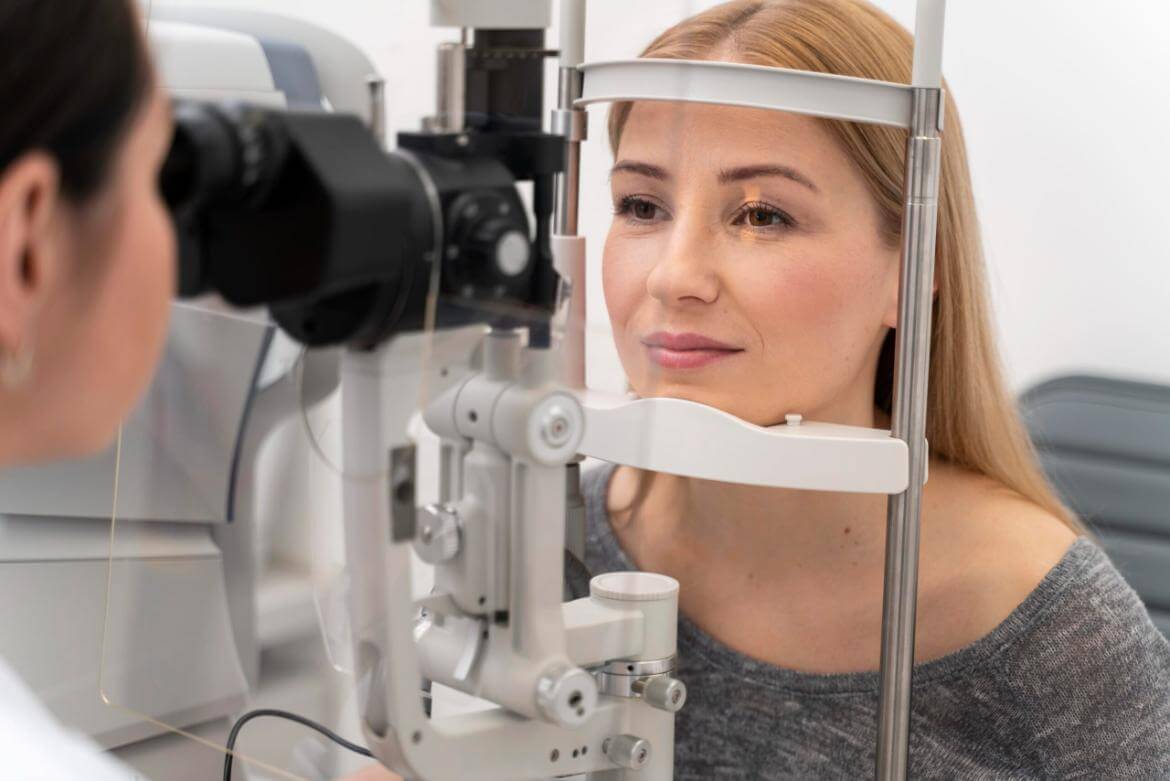
Hyperopia (farsightedness) is an eye condition that can be easily diagnosed after a comprehensive eye examination. During the examination, the ophthalmologist will first perform standard vision tests. If the vision test indicates that the person may be hyperopic, the ophthalmologist may use various methods to determine the cause of the hyperopia.
Today, methods such as autorefractometry and retinoscopy are widely used to determine the type and degree of refractive errors. Autorefractometry is a relatively more practical procedure, using a device that measures the refractive error in the eye. However, in some cases, especially in infants and children, more traditional methods such as retinoscopy can also be used. This method involves shining a special light onto the eye to observe how the light reflects off the retina and the degree of refraction.
The examination allows for a definitive diagnosis by examining light reflection and refractive error. These methods determine the degree and type of hyperopia, and appropriate treatment methods are determined accordingly.
How is hyperopia treated?
The primary goal of treating hyperopia is to ensure that incoming light hits the front surface of the retina. Various treatment methods are used for this purpose. Treatments generally include glasses, contact lenses, and surgery.
- Glasses: The most common treatment for hyperopia is glasses. Glasses prescribed for hyperopia use convex lenses that increase the eye's refractive power. These lenses correct vision by refracting light onto the front surface of the retina.
- Contact Lenses: Another option used to treat hyperopia is contact lenses. Contact lenses are placed on the eye to correct refractive errors.
- Surgical interventions: The most permanent solution for treating hyperopia is surgery. These procedures are performed using lasers or intraocular lenses. Refractive surgery corrects vision by reshaping the cornea, or the front surface of the eye.
- LASIK: A thin layer of the upper surface of the cornea is removed and an excimer laser is applied to the lower layer. This method corrects refractive errors.
- LASEK: In cases where the person's corneal structure is thin, laser surgery is performed by removing only the epithelial flap without lifting the upper surface of the cornea.
- PRK (Photorefractive keratectomy): It is performed by stripping the epithelial layer and applying excimer laser.
- Trifocal intraocular lenses and phakic intraocular contact lenses: These methods correct vision by inserting an additional lens into the eye. They are particularly preferred for hyperopia (farsightedness) patients who are not candidates for surgery.
Each of these treatment methods can have advantages and disadvantages, so it is important to consult an ophthalmologist to determine the appropriate treatment option.
What causes hyperopia in babies?
Hyperopia in babies is usually a congenital condition and develops during normal eye development. Babies' eyes grow and develop rapidly after birth. However, some babies may develop hyperopia due to factors such as an abnormally short eyeball or insufficient refractive power of the cornea and lens.
Additionally, exposure to external factors during fetal development can also cause hyperopia. For example, maternal alcohol or certain medications, radiation exposure, or infections during pregnancy can affect a baby's eye development and lead to hyperopia.
Hyperopia is usually mild in infancy and resolves spontaneously in most babies over time. However, in some cases, hyperopia may persist and require correction. Therefore, infants' eye health should be checked regularly, and an ophthalmologist should be consulted if any problems are detected.
Will hyperopia progress in degree if glasses are used?
Wearing glasses for hyperopia generally doesn't cause the degree of vision to worsen. However, in some cases, the lens system in hyperopia's eyes works harder than normal to compensate. In this case, when using more prescription than necessary, this overactive effect may decrease or even cease over time. Consequently, it can be difficult to go without glasses or use lower prescription glasses, and a higher prescription may be necessary.
However, wearing glasses does not alter the natural structure of the eyes or directly cause the degree of vision to worsen. Glasses are designed to correct or alleviate vision problems caused by hyperopia and, when used correctly, can improve vision quality. It's important to maintain eye health by attending regular eye exams and wearing appropriate prescription glasses.
