


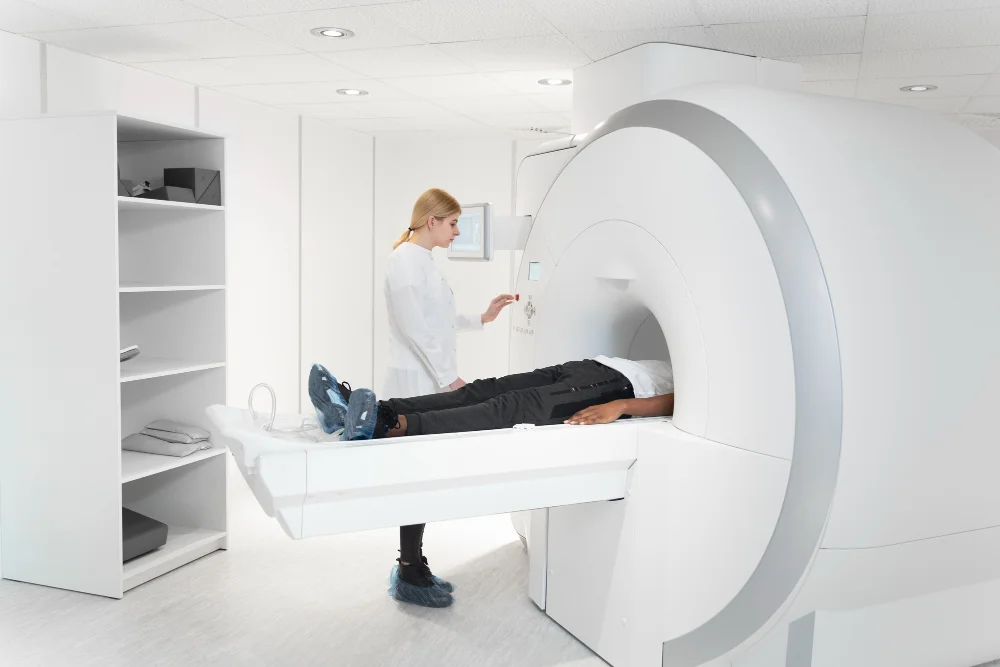
Neck MRI (Neck MRI)
Neck MRI is a painless, safe radiological imaging technique that provides detailed images of neck tissues, muscles, nerves, bone structure, spine and blood vessels.
What is Neck MRI (Cervical MRI)?
Neck MRI (cervical MRI) is an imaging technique that uses a strong magnetic field and radio waves to provide detailed, cross-sectional examination of the tissues, blood vessels, nerves, muscles, cervical vertebrae, and bone structures in the neck. When a magnetic resonance imaging (MRI) device is activated, the powerful magnetic field generated stimulates water molecules in the patient's body, helping the computer generate an image. The device provides highly detailed images of the structures and tissues in the patient's neck.
Why is a Neck MRI Performed?
Neck MRI detects diseases such as tissues, bones, vascular structures, nerves, muscles and anomalies and masses in the neck and has an important place in the diagnosis and treatment planning of neck diseases.
In Which Diseases is Neck MRI Performed?
Cervical Disc Herniation: It is used to detect structures within the neck, muscles, bones, spine, intervertebral discs, distances, narrowing and widening of the spine, nerves and anomalies therein.
Neck Pain: A neck MRI is valuable in determining the cause of neck pain. Cervical disc herniations, spinal stenosis, nerve compression, neck flattening, and cervical arthritis are among the causes of neck pain. A neck MRI is used in the diagnosis and treatment of these causes.
Spinal Cord Tumors and Infections : It is used in the localization, diagnosis and treatment of tumors and infections in the spinal cord.
Neurological Diseases: Neck MRI is performed to provide detailed visualization of the neck in neurological diseases such as MS (multiple sclerosis), to determine the localization and size of MS plaques, amyotrophic lateral sclerosis (ALS), spinal cord injuries, neck traumas, and spinal cord inflammation.
Cervical Spondylosis: Cervical calcification progresses through degenerative changes in the cervical vertebrae and discs. These changes can be accompanied by symptoms such as spinal stenosis, nerve compression, neck pain, limited neck movement, pain radiating to the arms, loss of strength in the hands and arms, and muscle weakness. A neck MRI can provide detailed information for diagnosing and treating the condition.
Neck Trauma: Neck MRI is performed to determine the severity of damage caused by neck trauma and to determine damage to the neck tissue, nerves and bone structure.
Dizziness and Balance Problems: In cases of dizziness and balance problems, it is taken to determine whether the disease is related to the neck.
Congenital Abnormalities: Used to diagnose congenital disorders and abnormalities in neck structure and development.
Headaches and Migraines : Neck MRI imaging technique is used to investigate the causes of headaches and migraines, to obtain information about their causes and to plan treatment accordingly.
How is a Neck MRI Performed?
For a neck MRI, the patient is positioned lying down inside a large, round, tube-shaped machine called a magnetic resonance imaging device. The MRI coil is placed under the patient's neck, and the patient's neck is secured to the coil. The patient won't feel the magnetic field within the device, but they may hear the machine's powerful beep during the scan. MRI technicians constantly monitor the patient and may request the use of headphones if necessary. The patient lies motionless on their back, and to obtain clear and accurate images, patients must remain completely still during the scan.
- An MRI machine can often make loud noises (e.g., clicking, buzzing) when it's operating. These noises are caused by the device's magnetic field, and headphones can be worn to block out the noise.
- In some cases, contrast material may be used to obtain clearer, more detailed images . Contrast material is administered intravenously and allows for clearer visualization of blood vessels, tumors, or infections in the neck. After the contrast material injection, some patients may experience a slight warm feeling, dizziness, or, rarely, allergic reactions. These symptoms are easily controlled and temporary.
- Once the neck MRI scan is completed, the patient is immediately removed from the device and can continue with their daily life.
- The patient should provide information about her suspected pregnancy and the medications she is using.
Neck MRI Types
MRI can be applied in different ways depending on the technologies used and the patient's condition.
- Drug-Free Neck MRI (MRI): This scan is performed without the use of contrast material . It provides a general examination of the structures in the neck. This type of MRI is used to identify abnormalities and diseases affecting the eyebrows, nerves, and bone.
- Contrast-Enhanced Neck MRI: A contrast-enhanced neck MRI is used to obtain detailed images and enable more in-depth examinations. In this MRI, contrast material is injected intravenously. The contrast material enhances the visibility of specific areas and makes it easier to detect conditions such as inflammation, tumors, and infections. In cases of suspected infection, vascular structures, or tumors , detailed examination of neck tissues is performed to identify the presence of vascular abnormalities or masses.
For Which Complaints is Neck MRI Performed?
- Neck Pain
- Limited neck movement
- Chronic Headache
- dizziness
- Muscle weakness: Muscle weakness in the arms and hands is observed in cases of neck herniated discs and nerve compression in the neck.
- Numbness and tingling in the muscles: Pain, numbness, and tingling radiating to the arms and hands can occur in diseases such as cervical disc herniation, cervical disc herniation, and neck flattening. Therefore, nerve compression in the neck region, narrowing of the vertebrae, and hernias are important. The neck area is evaluated in detail by taking a neck MRI.
- Neck trauma : After neck trauma, an MRI is performed to evaluate the muscle, nerve, spine and vascular structures in the neck.
- Head traumas : If the neck area is affected in head traumas, it is removed.
- Headaches and Migraines : If headaches and migraines are thought to originate from the neck , neck MRI imaging technique is used to investigate their causes and to obtain information about the causes and plan treatment accordingly .
Things to Do Before a Neck MRI
- Because the MRI machine uses a strong magnetic field, metal objects (such as jewelry, watches, zippers, braces, metal dentures, pacemakers, etc.) may move under the influence of the device or interfere with its proper operation. This could cause physical harm, so you may be asked to remove all metal objects before the scan.
- People with claustrophobia and fear of closed spaces may experience anxiety during the imaging. In such cases, the patient may be given a mild sedative and the MRI may be performed, or the patient's MRI may be performed with an open MRI device.
- MRI scans are risky during pregnancy and are not recommended. If the patient is pregnant, she must inform the doctor.
- It is important for the quality of the image that the patient is comfortable and does not move during the neck MRI scan, so it is recommended that the patient wears loose, comfortable clothing and goes to the toilet before the scan.
- If you are having a medicated neck MRI, you should definitely share your allergies and the medications you are using with your doctor.
- If you have tattoos on your body, you should definitely inform your doctor as the tattoos may contain metal and during the magnetic field MRI scan, heating and even irritation may occur in those areas.
- Comfortable, metal-free clothing is recommended, and a hospital gown may be worn if necessary. If the doctor recommends using contrast material to obtain clearer images, contrast material is administered intravenously. This material enhances the visibility of blood vessels and soft tissues, resulting in clearer images.
Things to Consider After Neck MRI
After the MRI scan, the person can return to their normal life. If a medicated neck MRI scan has been performed, the person will be laid in the observation room for a while and evaluated for allergies. They are advised to drink plenty of water to quickly flush out the contrast material.
Frequently Asked Questions
How Long Does a Neck MRI Take?
Neck MRI scans take approximately 15-30 minutes and are painless. This time may be extended due to the need for intravenous access and contrast injection in medicated neck MRI scans. The number of images in the scan protocol and the width of the area to be scanned, as determined by the doctor, influence the scan duration. If the patient is unable to remain still or moves, the scan may require repeating, which can prolong the scan time.
Is Neck MRI Safe?
A neck MRI is generally a safe test. It doesn't use X-rays, so it won't harm your body. However, in some cases, the use of contrast material may be necessary. Some people may experience allergic reactions after the contrast material is injected into the body. Therefore, it's important to inform your doctor about your allergic history before using contrast material.
How long does a medicated neck MRI take?
In cases where the neck tissue needs to be examined in detail,
In order to obtain clearer images, the patient is given a contrast material intravenously to take the image. Along with this preparation process, factors such as the characteristics of the MRI device and the number of slices of the protocol requested by the doctor affect the MRI imaging time, so the MRI imaging time can extend up to an hour.
Is There Any Harm in a Neck MRI?
- A neck MRI is generally a safe test and does not involve radiation. Magnetic fields and radiofrequency
The image is obtained with waves. It is not harmful, but caution should be exercised in some risky situations.
What are the risks of neck MRI?
- Metal implants or devices : Patients with pacemakers, metal prosthetics, or certain devices should inform their doctors before undergoing an MRI scan, as the strong magnetic field can damage these devices.
- Contrast material allergy : Contrast material use can cause allergic reactions such as itching and redness in some people, so it is important to inform your doctor about any allergies you have before using contrast material.
- Fear of closed spaces (claustrophobia): may cause anxiety in people with claustrophobia; open MRI is preferred in these people.
- Burns : Tattoo ink may contain metal and can cause burns and skin irritation in people with tattoos.
Who Should Not Get a Neck MRI?
It is not advisable for those with claustrophobia, metal implants, pacemakers, prosthetic devices that are not compatible with MRI, and pregnant women to have a neck MRI.
Is It Prohibited to Eat or Drink Before an MRI?
Fasting is not required for neck MRI, but fasting may sometimes be recommended if contrast material is to be used.
Advantages of Neck MRI
Because it doesn't involve radiation like X-rays or CT scans, it doesn't harm the body. It provides high-resolution imaging of structures such as soft tissues, vertebrae, intervertebral spaces, narrowing or widening, cervical disc herniations, nerves, bones, and blood vessels. Many neck diseases and conditions, such as tumors, infections, structural disorders, masses, and congenital anomalies, can be clearly visualized with an MRI.
When Will Neck MRI Results Be Available?
MRI images are immediately transferred to a computer and reviewed by a specialist radiologist . The radiologist will evaluate the structures in the neck and prepare a report, which will be sent to your doctor within a few days.
Where can I get a neck MRI?
You can make an appointment for a special neck MRI scan at MRI centers , imaging centers , private hospitals , and you can also have a neck MRI scan at state hospitals and university hospitals.
Neck MRI Prices
Neck MRI pricing varies depending on the location and the type of procedure. Most private hospitals offer various options for neck MRI pricing, depending on the patient's health insurance policy. Private health insurance and supplemental health insurance policies may offer more affordable or no-additional costs for advanced tests like neck MRIs, depending on the policy.
Magnet Hospital Neck MRI Service
Magnet Hospital is a healthcare institution dedicated to providing high-quality healthcare services to its patients with advanced imaging technologies and an expert medical team. It is one of the hospitals offering open MRIs, a preferred choice for those with claustrophobia . Both open and closed neck MRIs are available, and open MRIs are a convenient option for claustrophobic patients.
Magnet Hospital offers MRI scans under a SGK agreement . Additionally, neck MRI scans are available for those with private health insurance or supplemental health insurance, at no additional cost, depending on the policy coverage.
At Magnet Hospital, an MRI scan takes approximately 15-30 minutes in a comfortable environment . All necessary precautions are taken to ensure patient comfort during the MRI. The MRI is analyzed by expert radiologists , and the results are quickly evaluated and communicated to your doctor.
Making an Appointment for a Neck MRI
A neck MRI is an extremely important tool in physical therapy and rehabilitation, neurosurgery, and the diagnosis and treatment of neurological diseases. The appointment process at private hospitals is quick and simple. A neck MRI at a private hospital can be performed quickly and on the same day.
When you research MRI centers in Ankara , you'll notice that prices and appointment times vary. Neck MRI prices can vary depending on the technology used, hospital policies, scope of examination, equipment used, and health insurance coverage. To get accurate information about MRI prices at private hospitals, please contact your healthcare provider to inquire about current pricing.
To get a neck MRI scan price and a neck MRI appointment from Magnet Hospital, you can use the online appointment system or call our call center at 0 312 212 80 80 to make an appointment.
April 2025
